Written by Healing Sky Editorial Team. Clinically reviewed by Michele Valdez
Motor development is often the missing piece in conversations about ABA therapy. Children with Autism Spectrum Disorder (ASD) and related developmental differences frequently struggle with the physical skills that underpin daily life: buttoning a coat, catching a ball, holding a pencil, navigating a playground. Targeted gross and fine motor training within an ABA framework can improve independence, school readiness, and social participation. This guide explains what that training looks like, why it works, and how families can support progress at home.
Gross vs. Fine Motor Skills and Why They Matter
Gross motor skills involve large muscle groups and whole-body movement: standing, walking, jumping, climbing, throwing, and balance. Fine motor skills involve precise hand, finger, and wrist movements: grasping, drawing, buttoning, using utensils, writing, and manipulating small objects. Together, these abilities form the foundation for daily living and learning.
When motor skills lag, children may struggle with dressing fasteners, feeding, playground activities, classroom tasks, and basic safety. Difficulties can also limit a child's confidence, making them hesitant to join peers or try new activities. Within ABA, motor abilities are treated as observable, teachable behaviors that can be built step by step using positive reinforcement and systematic practice.
Why ABA Addresses Motor Skills
ABA is not limited to language or behavior problems. It is a scientific approach to teaching any observable skill, and motor behaviors are particularly well suited to its methods because they can be broken into components, taught with clear instructions and prompts, and reinforced in ways that are motivating for the child. The goal is functional change: real-world independence in dressing, feeding, handwriting, playground participation, and classroom tasks.
In practice, sessions include measurable motor goals, structured teaching, and plenty of play. ABA also emphasizes generalization, helping skills transfer from the therapy room to the kitchen, classroom, playground, and community.
Who Benefits from Motor Skills Training in ABA?
Children with autism frequently show delays in motor planning, coordination, and imitation, which can ripple into social and academic areas. Motor skills training within ABA may also help children with ADHD, developmental coordination disorder, intellectual disability, and global developmental delay. Adults with developmental disabilities may benefit as well, especially when goals center on daily living and workplace tasks.
Consider an ABA motor focus if a child shows any of the following:
- Trouble with dressing fasteners (zippers, buttons) or utensil use
- Avoidance of playground equipment, balance challenges, or frequent falls
- Frustration with drawing, coloring, or handwriting
- Difficulty imitating simple actions like clapping, waving, or tapping blocks together
How ABA Approaches Motor Skills
ABA organizes learning around four pillars: assessment, individualized goals, evidence-based teaching strategies, and data-driven decisions. Motor training uses the same structure, adapted to the child's strengths and needs.
Assessment begins by identifying where a task breaks down, whether in grasp, posture, hand strength, or sequencing. From there, the team divides skills into small, teachable steps through task analysis. For example, zipping a jacket might be broken into "pick up zipper," "pinch tab," "pull halfway," and "pull to top." Systematic teaching then uses modeling, prompts, shaping, and reinforcement to build success at each step. Finally, generalization practice across settings, people, and materials fades supports until the skill is functional and independent.
Assessment and Goal Setting
A strong plan begins with baseline data: what the child can already do, how consistently, and under what conditions. The ABA team may conduct preference assessments to identify motivating reinforcers and use brief probes to measure current performance on specific motor tasks.
Well-formed goals are Specific, Measurable, Achievable, Relevant, and Time-bound (SMART), and they align with family priorities and the child's daily routines. Examples include: "Within 12 weeks, the child will button three 1-inch buttons on a shirt independently in under two minutes across home and school"; "Within eight weeks, the child will catch an 8-inch playground ball from five feet away in 4 out of 5 trials across two sessions"; and "Within 10 weeks, the child will print their first name legibly within a three-line space on 4 of 5 opportunities."
Evidence-Based Strategies Used in Sessions
Motor skills training in ABA uses flexible, play-rich teaching, with methods selected based on the child's learning style and the specific motor target.
Task analysis and chaining break complex motor tasks into steps. In forward chaining, the child learns the first step first; in backward chaining, the child completes the last step first to contact immediate success. With zipping, for instance, the child may learn to "pull to the top" while the therapist sets the zipper, and earlier steps are added over time.
Shaping and reinforcement build toward the target movement gradually. If a pincer grasp is difficult, a raking grasp is reinforced initially, then the requirement is tightened toward a more refined pinch. Reinforcers are individualized, such as praise, access to a favorite toy, or a short sensory break, and are faded as the child experiences more natural rewards from success.
Prompting and fading provide the minimum help needed to succeed: verbal cues, gestures, modeling, or light physical guidance. Prompts are systematically faded to increase independence while keeping motivation high and preventing prompt dependence.
Modeling and motor imitation are especially useful for children who learn by watching. The therapist models the movement, highlights key actions, and invites the child to imitate. When imitation is also a growth area, training starts with large, obvious actions such as clapping or stomping before expecting fine precision.
Errorless teaching and differential reinforcement prevent repeated errors by arranging tasks so the child is likely to respond correctly, then strongly reinforcing those responses. As proficiency grows, small challenges are introduced and more independent, accurate performance is reinforced.
Generalization and natural environment teaching embed practice in everyday contexts with real materials: writing a grocery list at the table, buttoning a coat before going outside, or catching a ball while playing with a sibling. Brief, high-frequency practice in the natural environment helps skills stick.
Sample Activities for Gross and Fine Motor Skills
Gross motor sessions should feel like purposeful play. Obstacle courses, for example, might involve stepping over pillows, crawling through tunnels, walking a taped balance beam, and jumping into a target. Ball play builds eye-hand coordination through rolling, bouncing, catching, and throwing at varying distances and heights. Core and balance games such as statue poses, animal walks, yoga shapes, and single-leg stands with visual targets develop postural control. Locomotor skills like hopping, galloping, and side-stepping to music build coordination, and functional transitions such as stepping on and off low platforms, carrying light objects, and navigating stairs with a handrail connect practice to daily life.
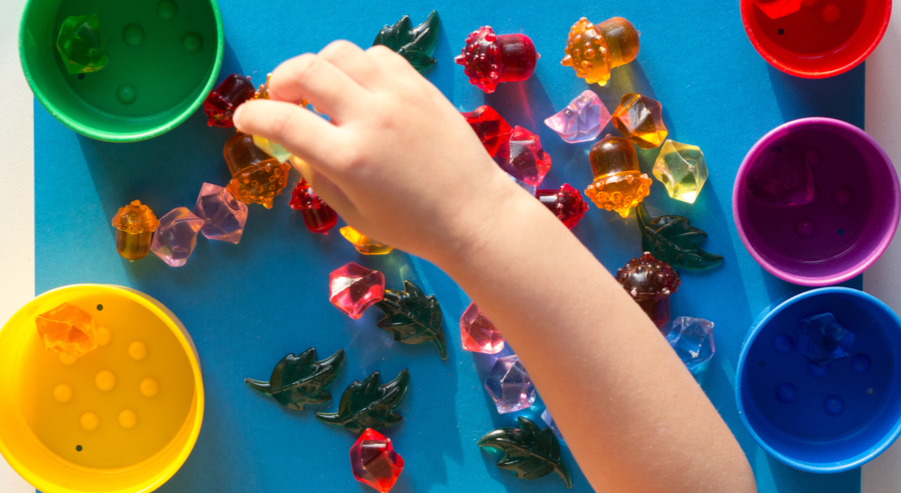
Fine motor lessons emphasize grasp, in-hand manipulation, bilateral coordination, and tool use through short, precise practice with immediate feedback. Pincer grasp games use tweezers or tongs to pick up pom-poms, coins into a bank, or mini-erasers into color-matched cups. Hand strength activities include play dough pinches and rolls, clothespin races, hole-punch art, and squeeze-bottle dot painting. Bilateral coordination develops through lacing cards, stringing beads, tearing and pasting paper, and opening and closing containers. Pre-writing and writing practice covers tracing mazes, connecting dots, copying shapes, and letter formation within visual boundaries. Functional skills practice includes button boards, zipper practice with large tabs, Velcro tasks, and spoon and fork scooping with minimal spillage.
How an ABA Motor Session Is Structured
Effective sessions are predictable but flexible, with momentum built through many opportunities to respond, rapid feedback, and short practice sets interspersed with brief breaks. A typical session opens with a gross motor warm-up such as animal walks and simple imitation games, followed by a quick review of mastered skills to build confidence. The core of the session focuses on one to three motor targets using prompts and reinforcement, then brief play. The session closes with generalization practice of the same skill in a different room, with a new material, or with a different person, and ends with updated data and next steps.
Measuring Progress: Data You Can Understand
Good therapy is measurable. Families should expect to see graphed trends and hear specific updates, such as "zips independently in three of four trials; next we'll fade the verbal cue." If a skill plateaus, the plan changes: more modeling, different reinforcers, smaller steps, or a new practice schedule.
The team should track independence (percent of steps completed without help), accuracy and quality (number of legible letters, neatness within lines, or catches out of attempts), speed and fluency (time to complete a dressing task or repetitions within a short interval), consistency across settings and people, and maintenance by re-checking skills weeks later to confirm they remain strong.
Collaboration with OT and PT
ABA professionals are experts in teaching and behavior change; occupational therapists (OTs) and physical therapists (PTs) are experts in motor development, postural control, and therapeutic exercise. The best outcomes happen when these disciplines collaborate.
OT typically focuses on fine motor skills, sensory processing, visual-motor integration, and functional play or self-care. PT targets gait, balance, strength, range of motion, and higher-level gross motor coordination. An integrated plan might have the OT establish a grasp pattern and hand-strength routine while the ABA therapist uses reinforcement and task analysis to build daily practice and independence. ABA providers generally do not prescribe exercise regimens for medical conditions, and therapy teams communicate regularly to align goals and avoid mixed cues.
Supporting Practice at Home
Motor gains grow faster with brief, frequent home practice. Caregivers are vital partners in cueing, reinforcing, and celebrating progress. Posting a one-page visual of steps for a target task, such as "Zip My Coat," on the closet door gives the child a consistent reference. Practice works best in tiny doses embedded in existing routines: two minutes of tongs before snack, three buttons after story time, five ball tosses before bath. Pairing practice with natural reinforcers, such as "When the coat is zipped, we go outside," keeps motivation high. Using the same language and prompts the child hears in therapy reduces confusion, and praising effort as well as success, with specific feedback like "Great thumb pinch!", reinforces the right movements.
Common Misconceptions About ABA and Motor Training
Several concerns come up often, and they are worth addressing directly. The belief that ABA is only for behavior problems misses that ABA is a scientific method for teaching any observable skill, including motor abilities essential for independence. The assumption that ABA means rigid table work does not reflect how motor training actually runs: it thrives in play-based, natural settings on the floor, at the playground, and in the kitchen. Concerns that reinforcement is bribery overlook that reinforcement is planned feedback that strengthens learning, is used ethically, and is gradually faded over time and replaced by natural rewards such as pride, play, and inclusion. Finally, worries that prompts will create dependence are addressed by the fading process itself: when prompts are faded strategically and quickly, they function as a short-lived scaffold rather than a permanent support.
Safety, Ethics, and Respect
Motor practice must be safe and centered on the child's dignity. Assent is sought, fatigue is monitored, and practice never pushes beyond safe limits. Equipment should be age-appropriate and stable; movements should respect joints and energy levels. If a movement causes pain, practice stops and the approach is reassessed. Goals are also tailored to the child's interests and culture, avoiding a one-size-fits-all model.
Medical contributors to motor challenges, including vision, muscle tone, strength, seizure disorders, sleep quality, and medication effects, should be considered and coordinated with the child's physician as needed. A team approach keeps the child safe and progress steady.
What Progress Looks Like over Time
Expect uneven growth. Early on, families may notice better participation, smoother routines, and less frustration before performance gains become obvious. Next come small wins: one button faster, one more catch, fewer spills. Mastery typically appears stepwise, with several small wins, a plateau, then another leap after the plan adjusts.
Two markers of durable learning are generalization and reduced prompts. When a child uses the same motor skill with different people, in new rooms, and with varied materials, with decreasing levels of help, the learning has taken hold.
When Motor Training Alone Is Not Enough
If progress is slower than expected, the team should recheck for underlying issues. A persistent toe-walker might need PT input; an unusual grasp may reflect visual or sensory processing differences better addressed with OT. Low stamina can reflect sleep, nutrition, or medical factors. Part of ethical ABA practice is recognizing when another discipline should take the lead or run in parallel.
Motor skills can also be addressed via telehealth or hybrid models. Therapists coach caregivers to set up simple stations and cue movements while the clinician observes and advises. Short, video-guided practices can maintain gains between in-person sessions. The principles, including clear goals, small steps, reinforcement, and data, remain the same regardless of format.
Finding the Right Provider
Quality matters more than labels. Look for an ABA provider who conducts a thorough assessment and sets functional, family-centered goals; coordinates with OT, PT, and the child's pediatrician when needed; explains teaching strategies clearly and invites caregiver participation; shares understandable data and adapts the plan when progress stalls; and makes sessions feel safe, engaging, and respectful.
Healing Sky can connect families with a provider who offers ABA programs that treat motor skills as essential building blocks for independence, blending structured teaching with natural play, using reinforcers that motivate the individual child, and including caregiver coaching so progress shows up at home, at school, and in the community. Families noticing struggles with dressing, utensil use, handwriting, or playground play can reach out to schedule a consultation and get a stepwise plan matched to their child's pace and priorities.