Written by Healing Sky Editorial Team. Clinically reviewed by Raul Rodriguez M.D.
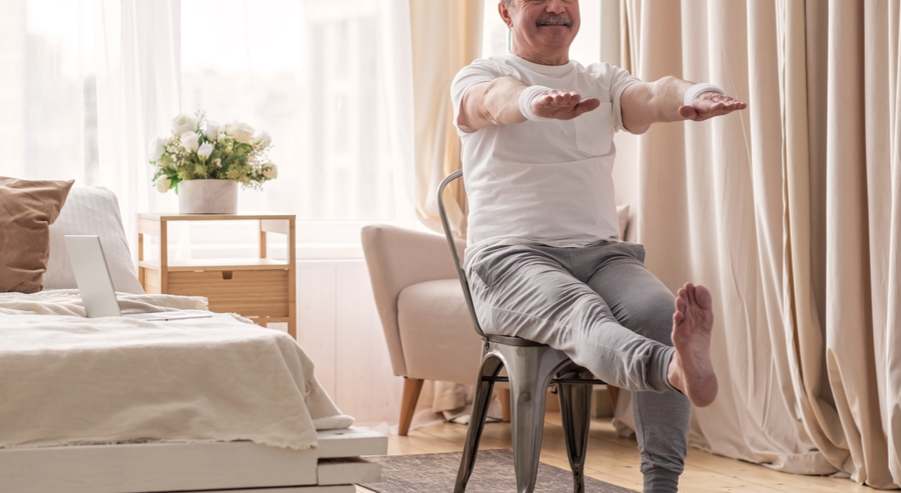
Chair yoga is one of the most practical entry points into mind-body practice for people who live with chronic pain, limited mobility, anxiety, depression, or simply a body that doesn't move the way it once did. It uses a sturdy chair for support, either seated or standing with the chair as a prop, so breathing, stretching, and strengthening are possible without getting down on the floor. The practice preserves the core of yoga: mindful movement, coordinated breathing, and a steadier nervous system. It works in living rooms, offices, waiting rooms, and hospital settings alike.
If you have limited mobility, chronic pain, or balance concerns, or you're a beginner who prefers a low-barrier start, chair yoga can be a practical, effective path toward better mental health and physical function. This article covers what chair yoga is, why it helps, how to practice, and how to keep it safe.
What Chair Yoga Is, and What It Isn't
Chair yoga is not "less than" real yoga. It is real yoga adapted for real lives. Familiar shapes, mountain, cat-cow, twists, forward folds, side bends, and even modified sun salutations, are practiced using a chair for grounding and stability. Movements are intentionally slower and smaller, guided by comfortable range of motion and the rhythm of the breath. The practice can be done fully seated, standing with support, or a mix of both, and it is accessible to beginners, seniors, and people returning from injury or illness.
The goal is not flexibility for its own sake. The goal is to connect breath, body, and attention so the nervous system learns there is room to relax, move, and feel safe.
Why Chair Yoga Supports Mental Health
Chair yoga helps mood and anxiety by retraining how the body and brain respond to stress. Slow, coordinated movement combined with calm breathing turns down sympathetic arousal, the "fight or flight" system, and engages parasympathetic tone, the "rest and digest" response. As the breath slows and lengthens, heart rate variability often improves, which is associated with better stress resilience and emotion regulation.
Chair yoga also strengthens interoception, the ability to sense what's happening inside the body. When early signals of tension, pain, or panic become noticeable, it becomes possible to intervene sooner with grounding skills rather than getting swept away by symptoms. This is particularly valuable for anxiety disorders, PTSD, and depression, where physical sensations and emotions intertwine. Over time, practitioners often report a calmer baseline with fewer anxiety spikes, improved mood and motivation on low-energy days, better sleep onset and quality, less pain-related distress, and a gentler relationship with the body after illness, injury, or trauma.
Physical Benefits
Deep twists and single-leg balances are not required to earn physical benefits. Chair yoga builds strength and mobility in the joints that matter most for daily life: neck, shoulders, spine, hips, knees, and ankles. It supports circulation, posture, and core stability, which can reduce back pain and improve balance confidence. With consistent practice, transitions like sitting to standing, bending, and reaching tend to become easier; morning stiffness and desk-related tension in the neck and shoulders often ease; and many people report fewer near-falls as their balance improves.
Who Chair Yoga Is For
Chair yoga is versatile across the lifespan and across diagnoses. It is not exclusively for older adults, it suits anyone who benefits from stability and choice. Beginners who want a safe entry point, people with arthritis, chronic pain, fibromyalgia, or long COVID, individuals with anxiety, PTSD, or depression who prefer slower grounding movement, office workers seeking movement breaks, pregnant or postpartum individuals who want support and balance, people in larger bodies or with limited flexibility, and wheelchair users seeking upper-body mobility and breath-based calming can all practice safely.
Safety: When to Check with Your Clinician
Most people can begin chair yoga without a clinical consultation. Still, an individualized safety check is wise if medical or orthopedic concerns are present. Speak with your clinician before starting if any of the following apply:
- Unstable blood pressure, uncontrolled heart or lung disease, or recent surgery
- Severe osteoporosis with fracture risk (avoid deep forward flexion)
- Recent joint replacement or acute injuries that limit weight-bearing
- Dizziness, frequent falls, or neuropathy that alters sensation
- Severe spinal stenosis or active radicular symptoms (numbness, shooting pain)
As a general rule: move within a pain-free range, keep the breath smooth, and stop any position that causes sharp, electric, or alarming pain. Pain is information, not a test to pass.
Getting Set up at Home or Work
A simple setup reduces friction. No specialized equipment is needed, a stable, non-rolling chair (lock the wheels if present) with a firm seat at a height where both feet rest flat on the floor is the foundation. Chairs with arms are fine as long as they don't restrict movement. Optional additions include a folded towel or cushion for lumbar support, a belt, scarf, or yoga strap for gentle stretches, and supportive non-slip shoes or bare feet for standing work.
Choose a quiet spot with enough space to step forward and back while lightly touching the chair. Silence your phone. Two minutes of chair yoga in an office setting is more restorative than two minutes of passive scrolling.
Your Anchor: Posture and Breath
Start every session by finding "seated mountain." Sit tall near the front of the seat, feet hip-width and planted, knees over ankles, pelvis neutral, not tucked under, not arched. Imagine a string lifting the crown of the head. Soften the jaw and let the shoulder blades glide down.
From there, place one hand on the belly and one on the chest. Inhale slowly through the nose, gently expanding the belly and ribs. Exhale through the nose, a beat longer than the inhale. Aim for about five to six breaths per minute, calm, steady, quiet. This cadence signals safety to the nervous system and prepares the body to move with less tension. If nasal breathing is difficult due to congestion, breathe softly through pursed lips and return to nasal breathing when possible.
A 15-Minute Beginner-Friendly Sequence
The following routine can be used most days. Move slowly. If something doesn't feel right, skip it or reduce the range.
- Minutes 0 to 2: Seated mountain with calm breathing. Inhale to lengthen the spine; exhale to soften the shoulders and jaw.
- Minutes 2 to 4: Shoulder rolls and neck release. Roll shoulders up, back, and down 5 to 8 times. Tip the right ear toward the right shoulder; breathe 3 cycles; switch sides.
- Minutes 4 to 6: Seated cat-cow. Hands on thighs; inhale gently arching the back and opening the chest; exhale rounding the back, navel toward spine. 6 to 8 slow cycles.
- Minutes 6 to 8: Side bends and gentle twist. Inhale reach the right arm up; exhale lean left without collapsing; 3 breaths; switch. Then hands to opposite knees; twist softly to each side; 3 breaths each.
- Minutes 8 to 10: Hip opener and hamstring stretch. Seated figure-four: right ankle over left knee (or cross ankles); keep spine tall; 3 to 5 breaths; switch. Then slide one heel forward for a mild hamstring stretch, toes up, hinge slightly; 3 breaths; switch.
- Minutes 10 to 12: Ankle circles and marching. Circle ankles in both directions, 10 each. March in place while seated to wake up hip flexors; 30 to 45 seconds.
- Minutes 12 to 14: Supported standing flow (optional). Stand behind the chair if it feels safe, hands light on the backrest. Mini sun salutation: inhale reach one arm up; exhale sweep it down; alternate 6 slow reps. Heel raises: lift both heels, lower; 8 to 10 reps.
- Minutes 14 to 15: Seated rest. Return to seated mountain; close with 4 slow breaths, exhale slightly longer.
Repeating this sequence three to five days per week produces better results than occasional longer sessions.
Essential Poses and How to Adapt Them
The poses below appear frequently in chair yoga. Try one or two per day and build gradually. The right version of any pose is the one that keeps the breath calm and the body feeling safe.
Seated Mountain (Tadasana): Tall spine, feet grounded, shoulders soft, palms on thighs. If slouching is difficult to resist, place a rolled towel behind the low back.
Seated Cat-Cow: Inhale to lift the chest; exhale to draw the belly gently in and round through the mid-back. Keep the motion small if osteoporosis is present; avoid deep flexion.
Side Bend: Reach up through the fingertips while keeping both sit-bones heavy. The hand can rest on the seat if shoulder sensitivity is a factor.
Gentle Twist: Rotate from the ribcage, keep the chin level, and breathe into the back ribs. Skip or keep the range very small after recent abdominal surgery.
Figure-Four Hip Opener: Ankle over the opposite knee, lifted foot flexed, hinge slightly forward. Cross the ankles instead and sit tall if crossing the knee is uncomfortable.
Hamstring Stretch: One heel forward, toes up, hinge at the hips. A strap under the forefoot reduces strain.
Supported Warrior Variation (Standing): One hand on the chair, step one foot back, slight bend in the front knee, lift through the spine. Keep the back heel down or shorten the stance to protect balance.
Heel Raises and Sit-to-Stand: Slow, controlled movement with knees tracking over toes. Use the chair lightly for balance or perform partial ranges as needed.
Breathing Practices for Calm and Clarity
Breathwork is the most powerful component of chair yoga for mental health. Three patterns are worth learning. Coherent breathing, inhale 5 seconds, exhale 5 seconds, practiced for 3 to 5 minutes builds baseline calm. Box breathing, inhale 4, hold 4, exhale 4, hold 4, is useful during acute stress. Extended exhale breathing, inhale 4, exhale 6 to 8, soothes anxiety and prepares the body for sleep. Start slow, never force the breath, and if dizziness occurs, shorten the counts or return to natural breathing.
Trauma-Sensitive Tips
For people with trauma histories or high baseline arousal, predictability and choice matter. Keep eyes open or softly unfocused if closing them feels unsafe. Choose stable, predictable movements over rapid flow. Occasionally glance around the room to reinforce present-moment safety. Never force a deeper range of motion, and never hold the breath. End each session with a brief check-in, noticing what is present in the body, and then choose one supportive action: sip water, stretch the calves, or step outside for fresh air.
Bringing Chair Yoga to the Workplace
Micro-sessions throughout the day protect the neck, back, and mood. Starting a meeting with three coherent breaths, doing 60 seconds of shoulder rolls and ankle circles on the hour, adding a seated twist after a long email session, and using box breathing for one minute before a difficult call are all low-friction ways to build the habit. Put reminders on the calendar until the practice becomes automatic.
Integrating Chair Yoga with Therapy and Medication
Movement is not a substitute for psychotherapy or medication when those are indicated, but it is a useful adjunct. In CBT, chair yoga supports behavioral activation by providing a small, repeatable win that builds self-efficacy. In DBT, it pairs naturally with distress tolerance and emotion regulation skills. In trauma-focused work, gentle breath-led movement helps reframe bodily sensations from "danger" to "information."
If medications affect balance, blood pressure, or heart rate, move slowly and favor seated variations until the body's response is clear. Sharing the routine with a treatment team allows them to account for it in care planning.
How Often to Practice, and How to Make It Stick
Consistency matters more than duration. Starting with 5 to 15 minutes three to five days per week is a reasonable target. Linking practice to an existing routine, after brushing teeth, after lunch, or before bed, reduces the friction of starting. Keeping the chair set up and ready removes one more barrier. Tracking sessions on a simple calendar provides a visual record that reinforces the habit.
Keeping sessions short at first avoids overwhelm. Comfortable clothing that allows movement helps. Pairing practice with a reliable cue, coffee brewing, a meeting ending, a favorite song, builds automaticity. Accepting "B-minus" effort on hard days matters more than waiting for ideal conditions; perfectionism is the enemy of consistency.
Measuring Progress
Objective markers help sustain motivation, especially during depression or chronic pain flares. Tracking average daily mood on a 0 to 10 scale, noting the frequency of anxiety spikes and average recovery time, logging minutes to fall asleep and nights waking, rating average pain intensity and its interference with daily activities, and observing ease of sit-to-stand or ability to reach overhead all provide useful data. Some people notice better sleep and less muscle tension within two weeks, followed by steadier mood and improved mobility over one to two months.
Common Questions
Will chair yoga provide a real workout? Strength and mobility gains are calibrated to the starting point. For more challenge, add repetitions of sit-to-stand, heel raises, or gentle standing flows with the chair for support.
What if stiffness is severe? Range of motion is a spectrum, not a test. Keeping movements small and consistent is enough; stiffness typically eases with practice.
What if only five minutes are available? Seated mountain, three cat-cow cycles, one side bend and twist per side, and 60 seconds of coherent breathing constitute a complete short practice.
Is it safe with osteoarthritis or back pain? Often yes, and often helpful, if movement stays within a pain-free range and abrupt movements are avoided. If pain flares last beyond 24 hours, scale back.
Is an instructor necessary? Many people start safely at home. For those who prefer guidance, instructors experienced with chair yoga, seniors, or medical populations are worth seeking out. Asking about trauma-informed approaches and how they adapt for specific needs is reasonable.
Red Flags: When to Stop and Seek Help
If any of the following occur, stop the practice and consult a clinician:
- Chest pain, pressure, or unusual shortness of breath
- Dizziness that does not resolve with rest
- New numbness, weakness, or loss of balance
- Sharp joint pain or swelling after practice
Progressing over Time
As confidence grows, breath practice can extend to five minutes, gentle standing flows can be added (supported lunges, gentle squats), light resistance such as a therapy band around the thighs during seated marches can be introduced, and sessions can extend to 20 minutes a few days per week. Joining a group class focused on chair yoga for beginners or for seniors is another option. Progress should feel steady. On days when balance or energy is lower, returning to seated work is the right call.
Expectations and Realistic Timelines
Some people feel calmer after the first session; others notice change more gradually. Both are normal. Healing, physical or psychological, is rarely linear. Good days, slow days, and skipped days are all part of the process. Chair yoga is the kind of durable habit that shifts a baseline over time, and that shift is what makes it clinically useful.
Start Today
Chair yoga invites meeting the body where it is and building steadiness from the inside out. No mat, perfect balance, or extra time is required, just a chair and a few clear breaths. For people navigating anxiety, depression, trauma, chronic pain, or everyday stress, this practice offers a safe, practical way to move, breathe, and recalibrate.
Set a timer for ten minutes. Sit tall, place both feet on the floor, and take the first slow inhale. The mind will want to multitask or rush. Let the chair provide support. Let the breath lead. Over weeks, more ease in the joints, better sleep, and a quieter nervous system are realistic outcomes.
Healing Sky matches people with providers who can pair accessible movement practices like chair yoga with therapy and, when appropriate, medication, because whole-person care works. If support building a calm, sustainable routine sounds useful, reach out to Healing Sky to be connected with a provider.